31/07/2021 Horizon Blockchain Games raises $4.5M for its NFT trading card game and wallet
Horizon Blockchain Games is — as the name implies — a company building games on the blockchain, along with tools to help others do the same.

The company announced today that it has raised another $4.5 million, bringing its total raised to a little over $13 million.

Horizon’s first game is Skyweaver, a competitive digital trading card game that taps the blockchain to give players more realistic ownership of their virtual cards. Once earned through competition with other players, cards can be sold, traded or taken out of the system and put in storage.

As I previously wrote about Horizon here:

Horizon is working down two paths in parallel here: On one path, they’re building an Ethereum-powered platform called Arcadeum for handling in-game items — establishing who owns any specific instance of an item, and allowing that item to be verifiably traded, sold or given from player to player. Once an item is in a player’s possession, it’s theirs to use, trade or sell as they please; Horizon can’t just take it away. In time, they’ll open up this platform for other developers to build upon.

On the other path, the company is building out its own game — a digital trading card game called SkyWeaver — meant to thrive in its own right while simultaneously showcasing the platform.

“Arcadeum” mentioned above has now been rebranded as “Sequence,” an easy-to-integrate wallet system that aims to hand-wave away the complexities of the blockchain. They want to let users buy and store their digital goods on the blockchain without either the user or an app’s developer really having to thinkabout the blockchain. Horizon co-founder Michael Sanders tells me the rebranding comes with an overall broadening of its focus; the “Arcade” in “Arcadeum” suggested it was all about gaming, whereas the aim is to help manage all kinds of digital items, from virtual gaming goods to NFT art and beyond.

The Horizon team often mentions being built to support “Web3,” a term I’ve been hearing more and more lately. In short (or, at least, as best I understand it), Web3 is a category of online-but-decentralized apps, services and games built around the blockchain (Ethereum, in this case) to give individual users more control of their data. The Ethereum foundation has a breakdown of the concept here.
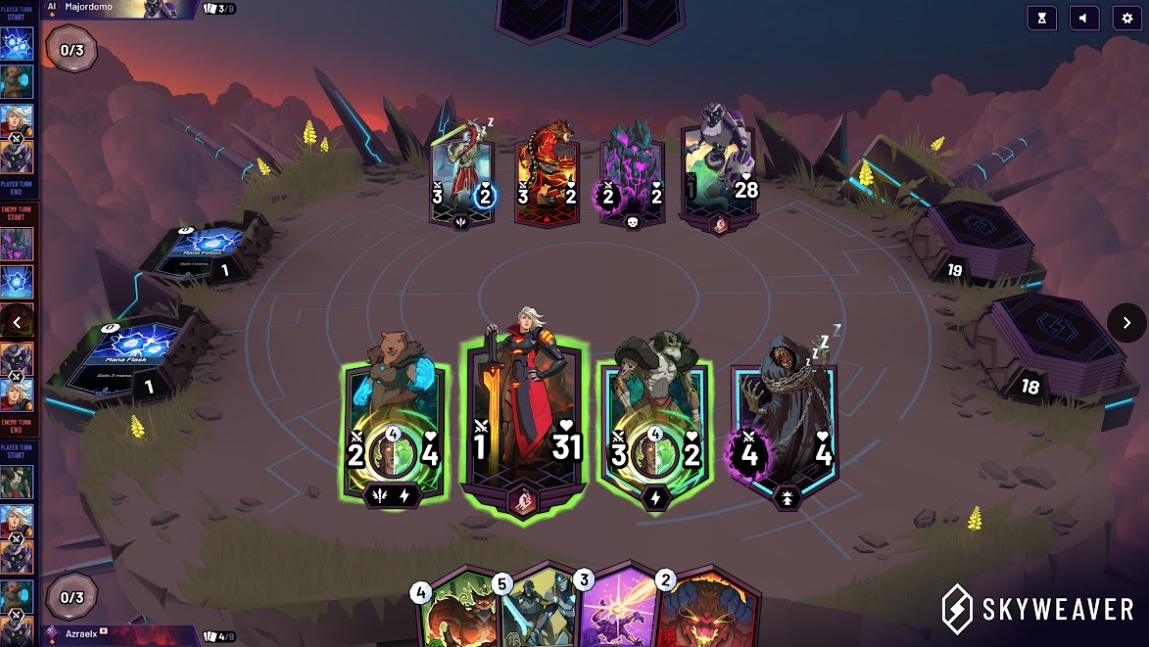
A match in Skyweaver. Image Credits: Horizon Blockchain Games

Horizon originally intended to open Skyweaver up more broadly in 2020; as of this morning it’s still in private beta, with plans to open widely later this year. Sanders tells me they’ve let in over 66,000 players so far.

The company says that investors in this round (a “pre-Series A round SAFE”) include CMT Digital, The Xchange Company, BITKRAFT Ventures, Khaled Verjee and Zyshan Kaba.

Arts

https://techcrunch.com/2021/07/29/horizon-blockchain-games-raises-4-5m-for-its-nft-trading-card-game-and-wallet/amp/

Interesting NFTs
The Moth Catcher
In this psychologically bed-headed portrait, a creature sets in a trance; his eyes devolved and vestigal, his third eye open but hardened and in a form resembling a Sharingan. The imagery therefore expresses an awareness existing in corporeal introspection. The creature’s mind sprouts, on the left side, an emerging face, grinning. To the right side of the head, red tentacles and fingers intertwine–a collaboration of invertebrate and vertebrate consciousness cooperatively handling paint brushes of the sort used to build an oil painting. The neck and throat bristle with random thorns, as from a rose or the upper portions of a beak sprouting from its flesh. The neck itself disassociates into layers of membranous material, terminating upon an abstracted base of convoluted forms composing its body. The nose is virtually non existent, more a sinus reiterative of the shape of the third eye. Set against the exposed teeth peering out of thick, meaty cheeks, a skeleton-like impression results. That impression sets behind a visceral set of lips and tongue, which is the creature’s prime seat of awareness. Sensual, organic, the tongue organ hangs, meaty, and with consciousness of a sea cucumber. It illuminates at the tip, drawing the attraction of a nearby moth–with mystery of purpose.
Scrolls of FURY
FURY is the 2nd emotion and collection of CRYPTYQUES, an NFT collectible based on the seven basic human emotions. Inspired by the internationally acclaimed Kung-fu Cinema of Hong Kong, FURY speaks to those who bear the collective memories of growing up watching Kung-fu films. The FURY collection transcends our daily mundanities into a ludicrously adventurous Wu Xia (Martial Heroes) world, as we explore the part of Oriental culture that powerfully inspires life.
Source Code for the WWW
OWNER: Sir Tim Berners-Lee Sir Tim Berners-Lee, b. 1955 Source Code for the WWW 1990-1991 Work includes: Original archive of dated and time-stamped files containing the source code, written between 3 October 1990 and 24 August 1991. These files contain code with approximately 9,555 lines, the contents of which include implementations of the three languages and protocols invented by Sir Tim; HTML (Hypertext Markup Language); HTTP (Hyper Transfer Protocol); and URIs (Uniform Resource Identifiers), as well as the original HTML documents that instructed early web users on how to use the application Animated visualization of the code being written (Video, black & white, silent), lasting 30 minutes 25 seconds A Scalable Vector Graphics (SVG) representation of the full code (A0 841mm wide by 1189 mm high), created by Sir Tim from the original files using Python, with a graphic representation of his physical signature at lower right A letter written in the README.md file (in “markdown” format) by Sir Tim in June of 2021, reflecting upon the code and his process of creating it Non-fungible Token ERC-721 Minted on June 15, 2021, ed. 1/1 Smart Contract Address: 0x86ade256037d80d6d42df8df96d5be21cd25bd8f
#63289
By OthersideDeployer
The Switch
The Switch is a unique, “one of one” NFT that demonstrates the evolution of artwork in the digital realm. The Switch is developed to change form at a specific point of time in the future, known by Pak. The evolution is determined and rendered immutable by smart contracts, or self-executing code on the Ethereum blockchain.